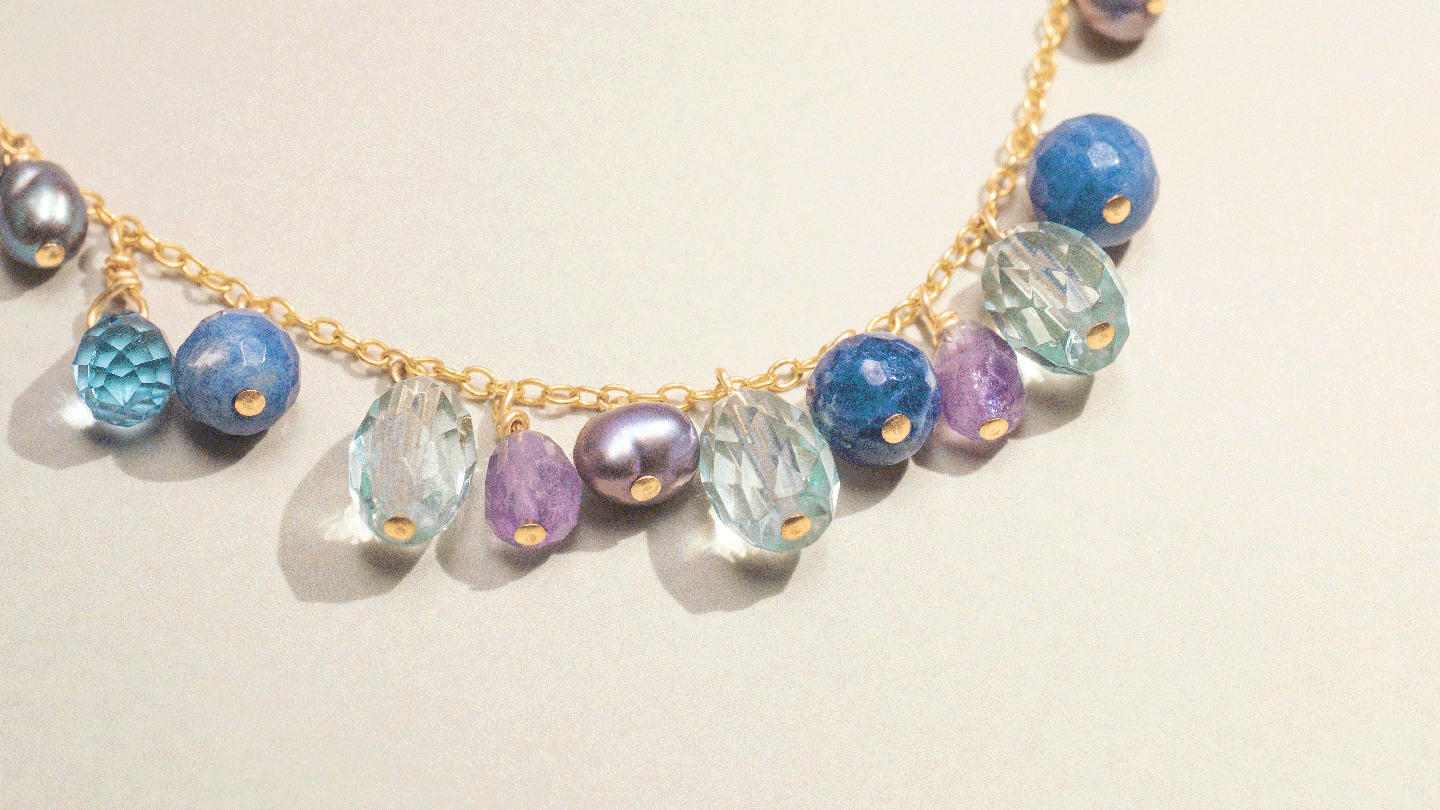
Pick up a piece of raw niobium and it is hard to picture it as anything but plain. It is a dull grey metal, light in the hand, with nothing on its surface to hint at what it can do. Every blue, violet, teal and gold in a Holly Yashi piece begins there. No dye goes into it and no paint goes onto it. The color comes from water, electricity and light.
What niobium is
Niobium is a naturally grey element, a light metal that holds its shape well. It belongs to the same family of material used in medical implants, which says a good deal about how inert it is.
Holly Hosterman's first designs were hand-cut animal earrings in brass and silver. Within months they had a following, and soon after, Holly and Paul Lubitz discovered the color hiding inside this unremarkable metal. Anodized niobium has been the signature of Holly Yashi since 1981.
How anodizing makes color from light
In the studio, niobium is dipped into a bath of electrically charged water. The current grows a very thin, clear layer of niobium oxide on the surface, and the higher the voltage, the thicker that layer becomes. When light reaches the piece, some of it reflects off the top of the oxide and some passes through and reflects off the metal underneath. Those two reflections meet and interfere, strengthening some wavelengths and cancelling others, and the wavelengths that remain are the color you see. It is the same effect that colors a soap bubble, held still in metal.
That is why the color is not a coating. As our niobium guide puts it, "The color is not a coating. It is the surface of the metal itself, changed." It is also why a shade can be repeated precisely. Each color is set by a voltage, so it can be matched across a collection and brought back correctly years later, because the process is written down in voltages rather than remembered as a recipe.
Why the studio chose it
Niobium let the work do something nobody else was doing: color that stays as vivid as the day it was dipped, on a metal light enough to wear from morning to night. Customers have told us the same thing in their own words. They love "the blues, and the purples, and the real vibrant colors," and they love earrings that are "incredibly easy to wear." Niobium is how both are possible in the same piece.
Designer Leah Vaughn put it simply: "We don't use dyes or chemicals to color it; instead, we use a water bath and electricity to anodize the metal and create the color."
How a piece moves through the Arcata studio
Every design starts at a designer's bench, sometimes as a sketch or a color palette, sometimes as a prototype that is finally ready for its moment. Leah describes the process as "a mix of play, planning, and letting the materials lead."
Shapes are cut, and some are hammered by hand for texture. That step matters more than it looks, because the same shade can read completely differently depending on the surface beneath it. Then the pieces are dipped, by hand and in small batches, one color per dip, while someone watches the color come up. Some designs go on to be painted by hand. Finally each piece is assembled, joint by joint, and finished.
At no stage is a piece shipped to a second site or factory. Everything is designed and assembled under one roof, in a 15,000 square foot studio in Arcata, California, by a team of around fifty people working in the same town where Holly and Paul began.
Four pieces, four ways color works
Lana Talisman Necklace. Inspired by Holly's many travels to Hawaii, the Lana Talisman pairs niobium in Amber Wave with gold and glass beads. The matching Lana Talisman Earrings add hand-hammered texture, so the same dipped color breaks into brighter and deeper tones across a single surface as they move.
Mahana Necklace. Here niobium is cut into graphic panels of palm leaves in tropical brights, set between warm gold links. Because the color is made by light rather than pigment, each panel flashes a little differently with every turn. One customer called it "practically weightless," which is exactly what niobium makes possible in a piece this bold.
Garden Sonnet Earrings. A floral pattern in soft blue niobium, finished with small crystals and sterling silver ear wires. Garden Sonnet shows how much range lives in a quiet palette: the pattern shifts as the light changes, and no two pieces are quite alike. There is a beaded necklace to match, in blue or green.
Swan Lake Earrings. Two kinds of handwork in one piece. The niobium is dipped first, into a composition of blue, violet and gold, and then swans and florals are painted across it by hand. It is a painter's eye for detail laid over color that came from the metal itself.
Every piece begins as grey
From the simplest drop earring to the most detailed painted piece, everything in the collection starts as the same plain grey metal and leaves the Arcata studio in color. Explore all Holly Yashi jewelry, and if you want to know more about the metal itself, our niobium guide answers the questions we hear most.
How do I care for niobium jewelry?
Very little is needed. Store your niobium jewelry dry and out of direct sun, and put it on after perfume or lotion rather than before. Now and then, wipe it with a soft cloth. That is genuinely all it takes, because there is no finish on niobium to protect or preserve.